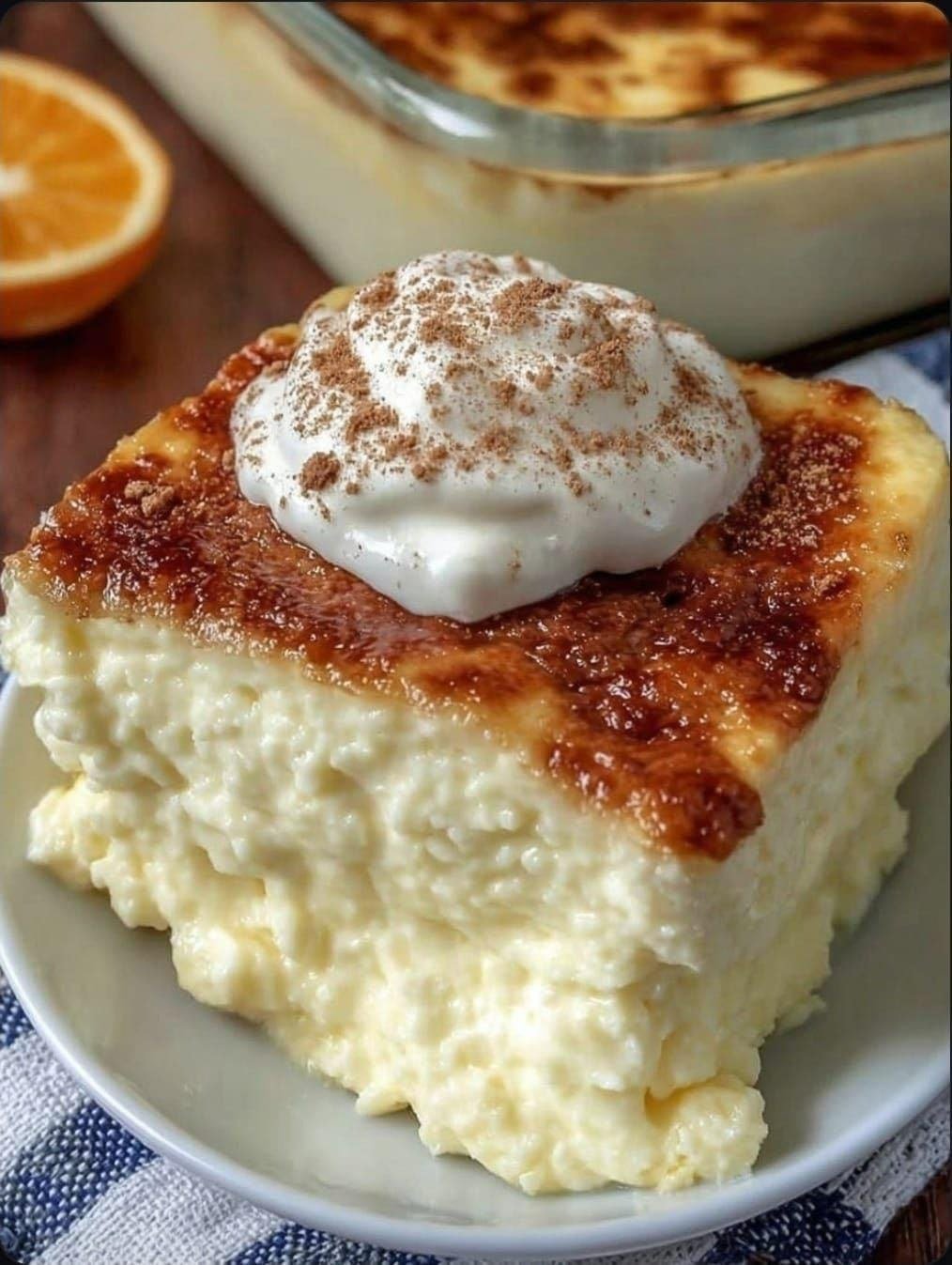
| Ingredient | Amount | Notes |
|---|---|---|
| Sweetened condensed milk | 1 (14 oz) can | Not evaporated milk |
| Hot water | 2 cups | Tap-hot, not boiling |
| Large eggs | 4 | Room temperature |
| Vanilla extract | 1½ teaspoons | Pure, not imitation |
| Salt | ¼ teaspoon | Enhances sweetness |
| Ground nutmeg | For sprinkling | Freshly grated is best |
That’s it. No heavy cream. No granulated sugar. No complicated steps.
The Method: Stir, Strain, Bake, Chill
Step 1: Preheat and Prep
Preheat your oven to 325°F (165°C). Place a 9×13-inch baking dish or a large roasting pan on the middle rack—this will be your water bath.
Arrange six 6-ounce ramekins or custard cups inside the baking dish.
Step 2: Make the Custard Base
In a large bowl, whisk together:
-
Sweetened condensed milk
-
Hot water
-
Eggs
-
Vanilla
-
Salt
Whisk until completely smooth and the eggs are fully incorporated.
Step 3: Strain (For Silky Smoothness)
Pour the custard mixture through a fine-mesh strainer into a large measuring cup or another bowl. This removes any egg bits or stringy pieces, ensuring a velvety texture.
Step 4: Fill the Ramekins
Divide the custard evenly among the ramekins (about ½ cup each). Sprinkle the top of each with ground nutmeg.
Step 5: Create the Water Bath
Carefully pour hot water into the larger baking dish until it reaches halfway up the sides of the ramekins. Be careful not to splash water into the custards.
Step 6: Bake
Bake for 35-45 minutes, until the custards are just set. They should be firm around the edges but still slightly jiggly in the center (like gelatin). A knife inserted near the center should come out clean.
Step 7: Cool
Remove ramekins from the water bath and let cool on a wire rack. Serve warm, at room temperature, or chilled—each way is delicious.
Pro-Tips for Custard Perfection
1. Room Temperature Eggs
Cold eggs can cause the custard to curdle. Let them sit out for 30 minutes before starting.
2. Hot, Not Boiling, Water
Use tap-hot water—not boiling. Boiling water can cook the eggs too quickly.
3. Don’t Overbake
The custard continues cooking as it cools. Remove it when the center still has a slight jiggle.
4. Strain for Smoothness
This step isn’t optional. Straining removes any bits of cooked egg white that would otherwise create a grainy texture.
5. Water Bath is Essential
The water bath (bain-marie) insulates the custard, preventing curdling and ensuring gentle, even cooking.
6. Make Ahead
These custards actually improve after a day in the fridge. The flavors deepen and the texture becomes even creamier.
Variations
Maple Custard:
Replace ¼ cup of the hot water with pure maple syrup. Reduce vanilla to 1 teaspoon.
Coconut Custard:
Replace the hot water with 1 cup hot water and 1 cup hot coconut milk. Top with toasted coconut.
Coffee Custard:
Add 1 tablespoon instant espresso powder to the hot water before mixing. Rich and sophisticated.
Lemon Custard:
Add 1 tablespoon lemon zest and 1 tablespoon lemon juice. Omit nutmeg; top with fresh berries.
Pumpkin Spice Custard:
Add ¼ cup pumpkin puree and ½ teaspoon pumpkin pie spice. Reduce water slightly.
Chocolate Custard:
Add 2 tablespoons cocoa powder and 2 tablespoons sugar. Whisk thoroughly to avoid lumps.
What to Serve With It
-
Fresh berries – Strawberries, raspberries, or blueberries
-
Whipped cream – Light, airy contrast
-
Shortbread cookies – For dipping
-
Caramel sauce – Drizzle for extra indulgence
-
Nothing – It’s perfect on its own
Storage
Refrigerator:
Store covered for up to 4 days. The custards firm up as they chill.
Freezer:
Not recommended—the texture becomes grainy upon thawing.
Your Custard Questions, Answered
Can I use evaporated milk instead of sweetened condensed milk?
No. Evaporated milk is unsweetened and thinner. You’d need to add sugar and adjust proportions significantly.
Can I make this without a water bath?
You can try, but the custard is more likely to curdle or develop a rubbery texture. The water bath is worth the extra step.
My custard has bubbles on top. What went wrong?
Either the water bath was too hot, or the custard was overbaked. Next time, use hot (not boiling) water and check for doneness earlier.
Can I make this in one large dish?
Yes! Use a 1½-quart baking dish. Increase baking time to 50-60 minutes.
Why strain the custard?
Straining removes any bits of cooked egg white that might have formed during mixing, ensuring a silky, smooth texture.
Can I double this recipe?
Yes! Use a larger roasting pan and more ramekins. Baking time may increase slightly.
Conclusion
At its heart, this custard is a reminder that some of the most enduring recipes are also the simplest. It doesn’t need modern upgrades or elaborate additions to be satisfying; its charm lies in its honesty and consistency. Every spoonful carries a sense of calm—soft texture, gentle sweetness, and that familiar hint of nutmeg that ties everything together.
It’s also a dessert that rewards patience. The slow baking, the careful cooling, and even the resting time in the refrigerator all contribute to its final texture and flavor. In a world that often favors speed, this custard encourages slowing down just enough to let something better develop. Whether served warm for comfort or chilled for refreshment, it remains a quiet classic—proof that simple techniques, when done with care, can still create something truly timeless.
